Crusaders team & leadership culture
Culture is the constant.
Thirty seasons of Super Rugby. Different players, different coaches, different captains, and fifteen titles. This is what stayed the same, in five principles from the people who built it.
Most leaders build a team the same way. Find the best people you can afford, give them a good plan, throw resources at whatever breaks, and copy whatever worked for the last team that won.
The teams that win for decades rarely work like that. They don't usually have the deepest roster or the biggest budget. What they have is hard to see on a spreadsheet and impossible to miss on the field.
The Crusaders, Christchurch's Super Rugby side, are one of the clearest cases in sport. Fifteen titles in their first thirty seasons, won with different players, different coaches and different captains. The one thing that carried through all of it was the culture.
What follows is how they built it. Each principle has the people who built it in their own words, a short film, and a few things to try with your own team.
Principle one
Culture is the constant
Talent, tactics and money matter. Culture is what makes them work, and the one thing that stays when everyone changes.
Start with the record. Every bar below is a season, and the tall ones are titles. Look at who was in charge for each, and at the gap in the middle.
Eight seasons without a title, then seven in a row. Across those thirty years the coaches changed, and the playing roster turned over many times. What carried over was a way of doing things. There are three reasons that matters more than any one signing.
It builds an instinct the whole team owns
That collectively owned and understood instinct is the defining point of difference in what is the greatest game ever devised… teamwork is king. It remains king. And the Crusaders are living proof of that.
Robbie Deans coached the Crusaders to five titles. He described what they had as a collectively owned and understood instinct: a shared way of making decisions, reading a situation, recovering from a mistake and holding steady under pressure.
That instinct is what turns strategy and talent into results, week after week. It's also what lets people be frank with each other, whether someone is playing the best rugby of their life or the whole thing is going wrong. You can't buy it and you can't hire it. It only comes from shared experience, shared values and time.
Teamwork outlasts the stars
The Crusaders have had some of the best players the game has seen: Dan Carter, Richie McCaw, Kieran Read. None of them was the reason for the titles. The team put collective excellence ahead of individual stardom, and the stars were brought up inside that.
It was passed on to me by the older players when I first arrived. You genuinely feel that connection and the care. And you realise that it's way bigger than an individual.
A star is a temporary advantage. Stars get injured, they retire, or a rival works out how to stop them. A way of working together is woven into how the team operates, so it survives all of that. It's the difference between a team that wins once and a team that wins for decades.
It's what's there when nobody's watching
It's about how you live and how you care. It's all encompassing.
The Crusaders talk about on-field and off-field behaviour gravitating toward each other. Keep high standards in the game and loose ones everywhere else, and eventually the game drops to match.
For most teams, the game is the sales call, the pitch, the launch or the presentation. Everything else is off the field: the weekly team meeting, the difficult conversation you could avoid, the tedious work nobody will notice. That's where the standard actually gets set.
Under pressure, teams don't reliably rise to the occasion. They fall back to whatever is instinctive and shared, because there's no time to think. The job is to make sure that default is excellence.
None of this means tactics, strategy and metrics don't matter. They do. Culture is what makes them work. Get it right and it compounds over decades. Get it wrong and no amount of talent, tactics or money will save you.

Principle two
A champion team, not a team of champions
Let the team write its own values, make them testable, and don’t copy anyone else’s.
What if your team's biggest weakness isn't a lack of talent, but too much of it?
The usual approach is to find the stars, stack the roster and pay what it takes. But a group of talented people isn't automatically a team. It's people who happen to wear the same shirt. They look fine while things are easy and come apart when things get hard, because the only thing holding them together is proximity.
The Crusaders learned this early. In the first season of Super Rugby, 1996, they finished dead last, winning two games out of eleven. The next year they were sixth. Wayne Smith, coach from 1997, built the turnaround on a small change of words.
A team of champions. A champion team.
It sounds like wordplay. It's a different idea of what a team is, and it comes with three practical rules.
1. The players write the vision and values
The actual vision and the values had to be created by the players… we had to create our own history, our own identity, what a Crusader man needed to look like, and what we wanted to achieve as a team.
Most organisations know their culture should rest on a vision and values. Most of them write those in the boardroom with a handful of executives, print them on posters, and expect everyone else to care.
The playbook cites a 2022 study by the Oxford Character Project, in which most people interviewed felt their organisation's values had been handed down from above, and very few saw them as widely shared.
Smith did the opposite. The vision and values came from the players, worked out together. It took longer, and it needed patience and steady guidance. But people protect what they make. A team that has chosen where it's going, and decided what it has to live by to get there, has an identity of its own. So stop telling people what to believe, and run the conversation that lets them work it out.
2. Values you can check
When challenged, you had to pull the card out, show that you had it, and you had to be able to recite what the values were on it.
The Crusaders put their values on a card, and you earned the card by living them. That simple object did three jobs:
Testable
You knew the values or you didn't. You had the card or you didn't. Nowhere to hide behind vague commitment.
Sideways, not top-down
Anyone could challenge anyone. Teammates held the standard, not just coaches, so the stars lived by the same rules as everyone else.
Always on you
Every time a player opened his wallet, there it was: a reminder of what he'd signed up to.
If your team can't recite your values, it doesn't really have any.
3. You can't copy-paste a culture
I would never transfer what I did with Crusaders into the next team that I coached. Because that was us. That was special to us.
The principles travel: build around a vision, let the team own the values, hold everyone to them. The specific vision, values and identity don't. An imported culture is a hand-me-down. Nobody made it, so nobody owns it.
Smith's advice is to start with the people in front of you: who they are, where they've come from, and who they want to be. Not with what worked for another team, department or company.
Fifteen titles later, the point stands. You don't need the best individuals. You need people committed to being their best together.

Principle three
Feed it daily
Culture lives in language, rituals and rewards, follows people home, and is easiest to see from the outside.
Most organisations have culture statements. They're framed in reception, mentioned in the annual review and printed in the onboarding pack. Under pressure, nobody thinks about them. When a deadline is close and tempers are short, people fall back on whatever is actually built into how the team works day to day.
A champion culture has to go bone deep. It shows in how someone reacts to a mistake, whether they help a teammate who's struggling, and what they do when the coach isn't around. The Crusaders did three things to get it there.
1. Feed it every day
You gotta feed your culture, your identity. You gotta feed it daily.
Language
Words decide what people notice. If your values are about the collective but your praise is all about individuals, people believe the praise. Make what you say in meetings, feedback and small talk match what you claim to believe.
Rituals
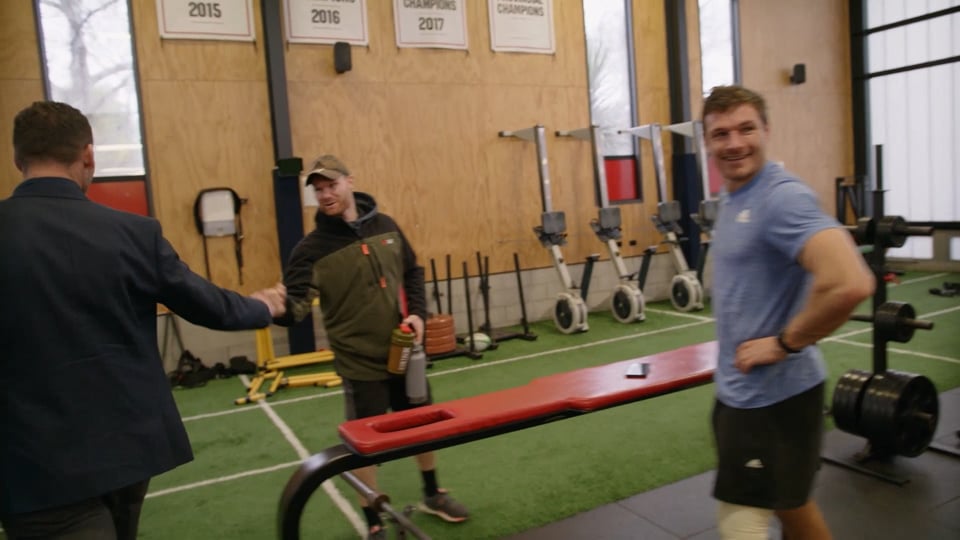
Small repeated actions that cue the behaviour you want. Crusaders greet each other with a fist bump: everyone, every time. Rituals also keep telling people they belong.
Rewards
Most teams reward what's easy to count. If you value things that never show up on a stat sheet, find ways to notice and reward them. What you celebrate is what you actually value.
Language was what turned the Crusaders around in 2017, after the longest drought in the club's history.
2017The Rumble in the Jungle
The Crusaders hadn't won a title in nine years. Scott “Razor” Robertson had just become head coach, and the critics said the dynasty was over. Razor went looking for a story that matched his team's situation, and found Muhammad Ali.
In 1974, Ali hadn't held the heavyweight title for nine years either. He'd refused to fight in Vietnam, lost his licence and been told his time was done. Then he flew to Zaire and beat George Foreman, bigger, stronger and unbeaten, in the Rumble in the Jungle. The parallels were deliberate:
| Comparison | Ali, 1974 | Crusaders, 2017 |
|---|---|---|
| Since the last title | Nine years | Nine years |
| The arena | Kinshasa, Zaire, far from home | The final at Ellis Park, Johannesburg. No team had gone to South Africa for a Super Rugby final and won. |
| The verdict | Written off | Written off |
Razor took a framework from Ali's famously short poem, Me, We, and built the whole season around it:
ME
Mindfulness and Execution. Get yourself right.
WE
Work ethic and Enjoyment. Thrive, and have fun, as a group.
The final in Johannesburg became their jungle. Before kick-off at Ellis Park, the team doctor told the players what altitude would do to them:
In the last 20 minutes, it's gonna be like having a hair dryer on hot in the back of your throat. It's gonna feel like you can't take another breath. And when that moment happens, that's when you start to dig deep.
The Crusaders went ahead early. The Lions came back. At half-time the players climbed the steep tunnel to the changing room completely spent. They held on, and won. Like Ali, they were kings again.
That title started a run of seven in a row, and it began with language that gave the struggle a meaning.
2. Live it outside work too
It's gotta be a part of your everyday life. It's how you operate at home. It's how you are with other people.
Standards at work and standards everywhere else aren't separate. If they're high in one place and loose in the other, they drift together. It works the other way too: raise how you live outside work and the work follows.
Culture isn't how you act when the coach is there, when there's an audience, or when you're being assessed. In Deans' words, it's what's there when nobody's watching. Smith got his teams involved in the community, and recognised and rewarded contribution and care, which made it clear the expectations went deeper than match day.
3. Ask the bus driver
I would seek feedback everywhere we went from people that we encountered. It might be the bus driver, it might be reception, might be the chef, just people that we encountered.
You can't judge your own culture accurately from inside it; you're too close. So Deans asked outsiders one deliberately open question:
“Tell us about your experience of the group.”
You might find out your team is rude to other staff. That what feels like confidence from the inside comes across as arrogance from the outside. That your values disappear the moment people are tired or stressed.
That gap is exactly where the culture work is. Measure culture only from the inside and you'll see what you want to see. Outsiders tell you what's actually true.
Culture isn't something you make once and hang on a wall. You feed it daily, live it consistently and test it often.

Principle four
A story bigger than the team
Goals run out. A story about who you are, made physical and passed on, keeps people going.
What gets your team out of bed on the hard days, when the work is dull and the pressure is high?
Most leaders reach for goals. Hit the target. Win the league. Reach the milestone. But goals have a shelf life. Once you've hit one, the climb to the next can start to feel like a chore. What lasts is the sense that the work matters beyond today: that you're part of something bigger than yourself. The Crusaders built that on purpose, with a story that tied everyday effort to something heroic, historical and permanent.
1. Borrow a story that mirrors yours
It was heroic. You've got a few fighting the many, and you've got a leader out there prepared to lead the way.
Teams often lean on their own history. In 1998 the Crusaders had two seasons of it, and neither was any good. Smith needed a story from somewhere else, and found it in Kenneth Branagh's film of Henry V.
1998Agincourt in a darkened room
Before the Battle of Agincourt, Henry's English army was in a bad way: hungry, sick with dysentery and heavily outnumbered by the French. They shouldn't have won. They did.
The parallel was deliberate. The Crusaders were underdogs who'd finished last in 1996, and nobody expected anything from them. Here was a small band of brothers beating a far bigger force through unity and courage.
Smith and his coaches spent a week cutting the St Crispin's Day speech together with footage of Crusaders players making sacrifices for each other the season before, all set to the team's music. Then they showed it to the squad.
Twelve minutes. A darkened room. Massive speakers.
Smith was nervous. Was it corny? Would they laugh?
The lights came on. Nobody said anything. Then someone asked:
“Can you play that again, Smithy?”
The story had landed. They weren't just playing rugby any more; they were the few against the many. That season ended with the club's first title.
2. Make it something you can hold
You looked up and saw the swords next to some of the guys' names. You wanted to emulate that.
A story is easier to live inside when you can touch it. The Crusaders made theirs physical in two ways. The first was the Honesty Card, which the players created themselves.
We few, we lucky few, we band of brothers. For he today who sheds his blood with me shall be my brother. All things are ready if our minds be so.
How you got one
- A group of senior players decided each week who had earned it.
- Behaviour off the field counted: sacrifices for teammates, gratitude shown.
- Stop living the values and it could be taken back.
- In time, players slid their own card under the coach's door when they knew they'd fallen short.
The second was a wall carrying the name of every player who had worn the shirt, with a sword beside each member of a title-winning team. Some names have a lot of swords. Every new player could see the line they were joining: the names before them, and the space for the names still to come. The swords on the timeline at the top of this page are a nod to it.
3. From “what's in it for me” to “what footprint will I leave”
Young blokes when they arrive, it's very much about what's in it for them. Then they come to understand, oh crikey, this is actually bigger. They start getting excited about the footprint they can leave.
That shift doesn't happen by itself. Senior players don't only teach skills; they pass on the story, along with the connection and care that were handed to them. When it works, people stop asking what they can get out of the team and start asking what they can add to it.
That's the deepest motivation there is: knowing your work will echo after your part in it is done.
Principle five bonus
Accountability starts with connection
Build the relationship first, say what you expect early, then make the call and back it.
Most teams avoid hard conversations. Not because people can't see the problems, or don't care about results, but because honesty feels risky. What if it damages the relationship? What if it backfires? What if I'm wrong?
So people stay quiet, problems fester, standards slip, and everyone pretends not to notice. At the Crusaders, hard conversations happen all the time: between players, between coaches and players, between senior and junior teammates. Here's how they make that possible.
1. Connection comes first
It's easy to have the easy ones. It's easy to pat someone on the back when they score a great try or do something outstanding. But can you have that conversation when things aren't going as well as they need to be?
Most leaders try to hold people to account before they've built any real connection. It doesn't work. Without connection, feedback reads as an attack and criticism as judgement. People get defensive, wave the input away, or quietly resent whoever gave it. The conversation happens and nothing changes.
Build the connection first and the same feedback reads as someone caring enough to help you get better, whether it's a hard message or credit for a job well done. Accountability follows from there.
2. Say what you expect, early
It's intimidating for a young bloke to arrive, he's in the room, he's surrounded by internationals and it can take a while for them to just become themselves in that setting.
If you want people to own their mistakes, tell them that's what you expect. Plenty of leaders get frustrated by behaviour they never actually asked for. Deans had a conversation about expectations with every new player as they arrived. The empathy told them they belonged. The clarity gave them what they needed to perform.
Belonging Clarity Accountability
3. Make the call, then back it
Deans had a habit of taking new recruits jet boating on the braided rivers near Christchurch. At some point he'd hand the controls to the young player. Sooner or later a fork would come up: one channel carrying on, the other heading for rocks and shallow water.
“Which way?” Deans wouldn't answer. “Which way?” The fork getting closer. Silence. Finally, Deans would say: “Make a decision.”
Your turn.
The fork's coming up. Which way?
A bad idea committed to is better than a good idea not committed to.
It was never really about boats. “No decision's wrong if you back it,” as Deans put it. Make the call. If it works, great. If it doesn't, go back and try again. But commit fully, because a half-committed choice is worse than a wrong one. It leaves everyone unsure, and the hesitation shows up exactly when clarity matters most.
Accountability isn't surveillance, or handing out consequences when things go wrong. It's building the conditions where people hold themselves and each other to a high standard because they want to. The Crusaders built it with care, honesty, and an expectation that everyone, from the head coach to the newest recruit, owns their choices completely.

The playbook on one page
Five principles, and one question for each to take back to your team.
- 01 Culture is the constant When the pressure’s on, what do we actually do?
- 02 A champion team, not a team of champions Whose values are these, and could you recite them?
- 03 Feed it daily What did we celebrate this week?
- 04 A story bigger than the team What footprint do we want to leave?
- 05 Accountability starts with connection Can we have the hard conversation, and do we back our calls?
The Crusaders didn't win fifteen titles with better slogans, a secret playbook or a knack for signing the best players. They built something bigger than any one person, and they kept feeding it.
// source
Based on The Crusaders Culture Playbook, a free five-part email course from the Crusaders Leadership Programme™ by Kaila Colbin. The quotes from Wayne Smith, Robbie Deans, Kieran Read and Sam Whitelock are as they appear in the course, and the five films are the programme's own, hosted on Vimeo. Season and coach details on the timeline are from the public record.